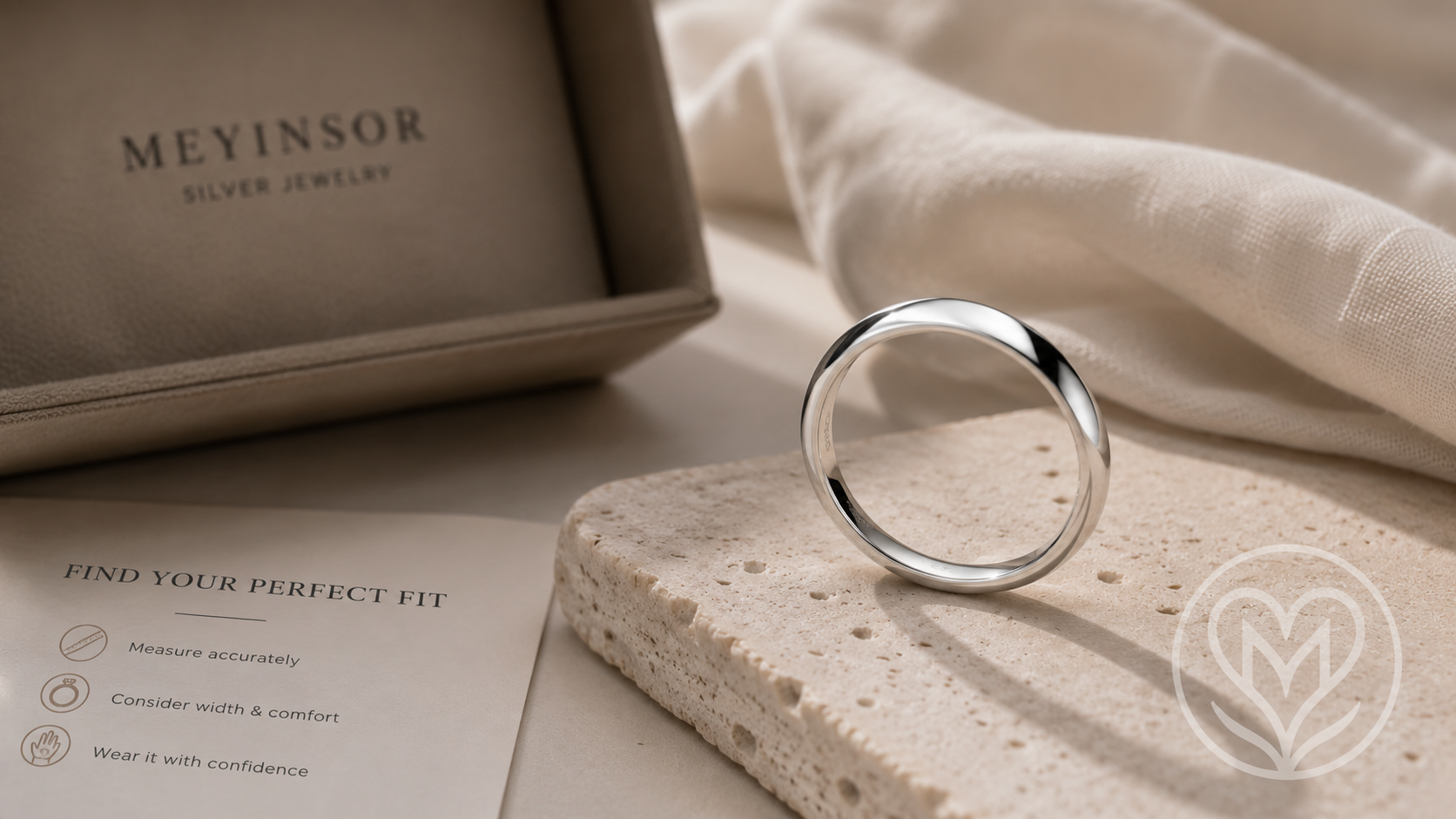
The strength of a closed ring is also why sizing matters more
A closed ring forms a complete circle. The structure is stable, pressure is distributed evenly and the band is less likely to lose its intended shape through adjustment. Many commemorative or long-term designs use this construction because it looks complete and maintains a consistent wearing position.
That same structure leaves almost no room for later adjustment. Too small, it may not pass the knuckle or may compress the finger. Too large, it can rotate, slip or leave the decorative top facing the wrong direction. For a first purchase, “close enough” is not a reliable size decision.
Confirm which size language the product uses
Closed rings may be listed by finger circumference, inside diameter or a regional size number. These can be converted, but national and brand systems are not identical. The most dependable method is to obtain a measurement in millimetres and match it to the current product chart.
Do not confuse the outside diameter with the inside diameter, and do not use a distorted open ring as the basis for a closed ring. A different measuring reference produces a different result.
Which matters more, the knuckle or the base of the finger?
Both. The ring must pass the knuckle and then sit at the base. If the knuckle is wider, measure both points. The size must be large enough to pass safely, but not so large that it spins continuously once in place.
A practical fit often gives slight resistance at the knuckle without requiring force, remains stable at the wearing position and can be removed with a slow twisting motion.
A wider band usually feels tighter
At the same inside diameter, a wide band touches more skin and can feel tighter when the finger bends. A fine band has less contact and often feels easier. A size that works for a thin ring should not automatically be assumed to fit a wide ring in the same way.
If the product page identifies a wide or thick band, or gives a specific allowance, follow the design-specific note. The actual structure is more useful than a general rule.
Finger size changes slightly every day
Weather, food, sleep, exercise and prolonged hand use can all affect circumference. Because a closed ring cannot be adjusted whenever the finger changes, avoid measuring in an extreme condition. Do not choose only the smallest cold-weather reading or order directly from a visibly swollen maximum.
Compare daytime and evening measurements and select a range that covers normal life rather than one perfect moment.
What to do when the measurement falls between two sizes
For a fine, lightweight band and a preference for a close fit, check carefully whether the smaller size still passes the knuckle safely. For a wide or heavier ring, or fingers that swell easily, more comfort space may be appropriate. In every case, the product chart and the actual structure should guide the choice.
When uncertain, provide customer service with at least two measurements, a clear view of the finger, the difference between knuckle and base, and the exact design. This is more useful than asking only which size number to buy.
A closed ring gift should not rely on guessing
Closed rings are often chosen for meaningful occasions, but a surprise should not be built on a sizing risk. Borrow a ring the recipient wears on the intended finger and measure its inside diameter, or discreetly ask someone close to them. If there is no reliable reference, a necklace, earrings or bracelet may be a safer fixed-size gift.
Complete the fit check before extended wear
Keep the packaging and order information and try the ring when the hand is in a normal condition. Do not force it over the knuckle merely to prove it can go on, and do not wait until after extended wear, impact or self-alteration to assess the size. If there is strong marking, numbness, continuous spinning or a tendency to slip off, stop forcing the fit and contact support under the current return and after-sales policy.
The visual completeness of a closed ring depends on a genuinely suitable size. It should not need repeated bending to hold its form, and the finger should not have to adapt to an incorrect circle. Careful measurement, band width and normal daily changes turn stability into its real advantage.