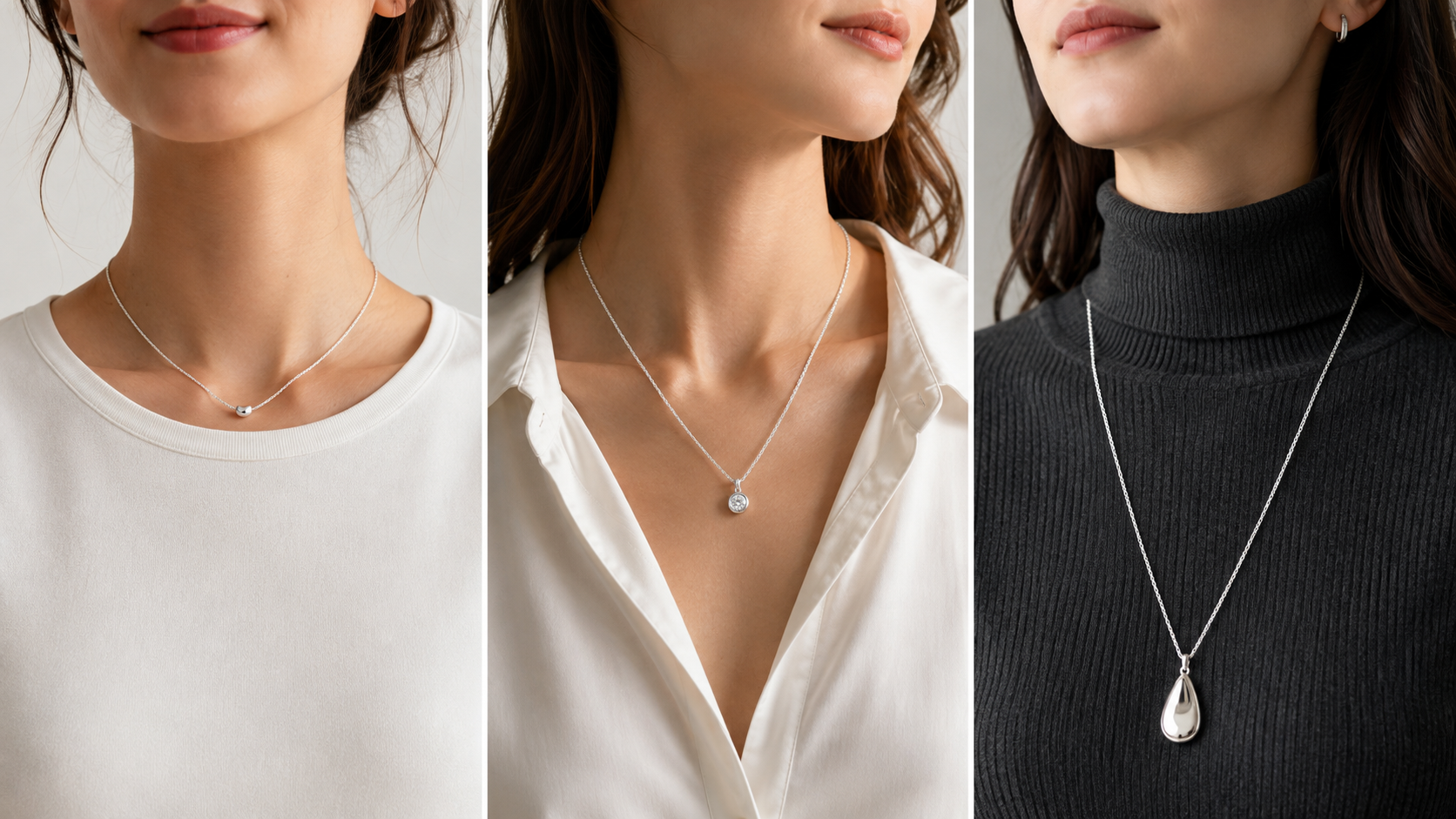
Length first determines where the necklace sits
When choosing a silver necklace, many people begin by asking which length looks slimmer or is easiest to style. The most direct effect of length, however, is simply where the chain and pendant sit: near the base of the neck, around the collarbone or lower on the chest. A good position lets the necklace become part of the outfit. A poor one can place the pendant directly on an edge of fabric, hide it inside the neckline or make it shift away from the centre.
Two people wearing the same chain will not see exactly the same result. Neck circumference, shoulder and neck proportions, collarbone position, chain thickness, pendant weight and the use of an extender all change the final drop. Terms such as “short” and “mid-length” are useful categories, but the measurement in centimetres and the intended position matter more.
A collarbone-area chain gives a light, defined effect
A chain that sits close to the lower neck or collarbone keeps the detail near the face. It works well with small pendants, crew necks, slightly open shirts and simple single-chain styling. Because it sits higher, it can make a small amount of silver more visible, but it also leaves less room for sizing error.
People with a fuller neck, sensitivity to tight chains or a habit of wearing shirts buttoned high should not copy a model photograph without checking. A chain that rests below the collarbone on one person may sit close to the base of the neck on another. Use a soft cord or tape at the stated length and test whether breathing, turning and looking down feel natural.
A conventional short chain works with more everyday necklines
A chain that falls a little below the collarbone usually leaves more space around the neckline. It tends to work with common crew necks, V-necks, knitwear and shirts, and it can support a pendant with a little more visual presence. For a first necklace, this position is often easier to wear regularly than a close-fitting style.
Versatile does not mean automatic. If the pendant lands exactly on the edge of the neckline, it may repeatedly move in and out of the garment. If the chain is very fine and the pendant relatively heavy, the drop can also become more pronounced. Consider the neckline and the full pendant length together.
A mid-length chain creates more vertical space
A lower pendant creates a clearer vertical line across the upper body. This can work well over a high neck, plain knitwear, a simple dress or an outfit with little surface detail. The necklace then relates more to the garment than only to the neck.
Lower placement also changes daily use. The pendant may touch a desk edge, shoulder strap or coat zip, and it may swing more when bending, carrying a child or moving quickly. For a frequently worn necklace, judge it while sitting, looking down and wearing an outer layer, not only in a standing photograph.
The neckline should leave the necklace its own space
- Crew neck: keep the pendant clearly above or below the edge rather than directly on it;
- V-neck: the pendant may follow the direction of the opening without needing to copy it exactly;
- Shirt: decide how many buttons you normally leave open and check whether the pendant remains visible;
- High neck: a longer chain and a clear pendant outline are usually easier to see;
- Low or square neck: judge the open area, as a very short chain can feel crowded while a long one may fall outside it.
A heavier pendant makes the same length feel lower
A pendant pulls the chain downward, so a plain chain and a pendant necklace of the same stated length may not sit identically. Sliding clasps, extenders and adjustable structures also change the usable length. MEYINSOR necklaces include both fixed and adjustable designs, with chain and pendant dimensions shown on each product page. Use the specification for the exact piece rather than transferring the fit of another necklace.
Make a simple trial at home
Mark the stated length on a non-stretch cord and include the expected pendant drop. Put on two or three tops you wear often and check the position from the front, side and while looking down. For layering, leave a visible difference between the chain lengths so that pendants do not overlap and the chains are less likely to tangle.
Four final checks before ordering
- Does the page show the main chain length or the maximum length including an extender?
- Does the pendant measurement include the connecting ring, and what is the full drop?
- Is the chain adjustable, and does its useful range suit your neck?
- Do your main necklines leave a stable area for the pendant?
The right necklace length is not a fixed formula for every neck. It is the point where the chain, pendant, neckline and everyday movement stop competing with one another. Confirm the position first, then choose the design.