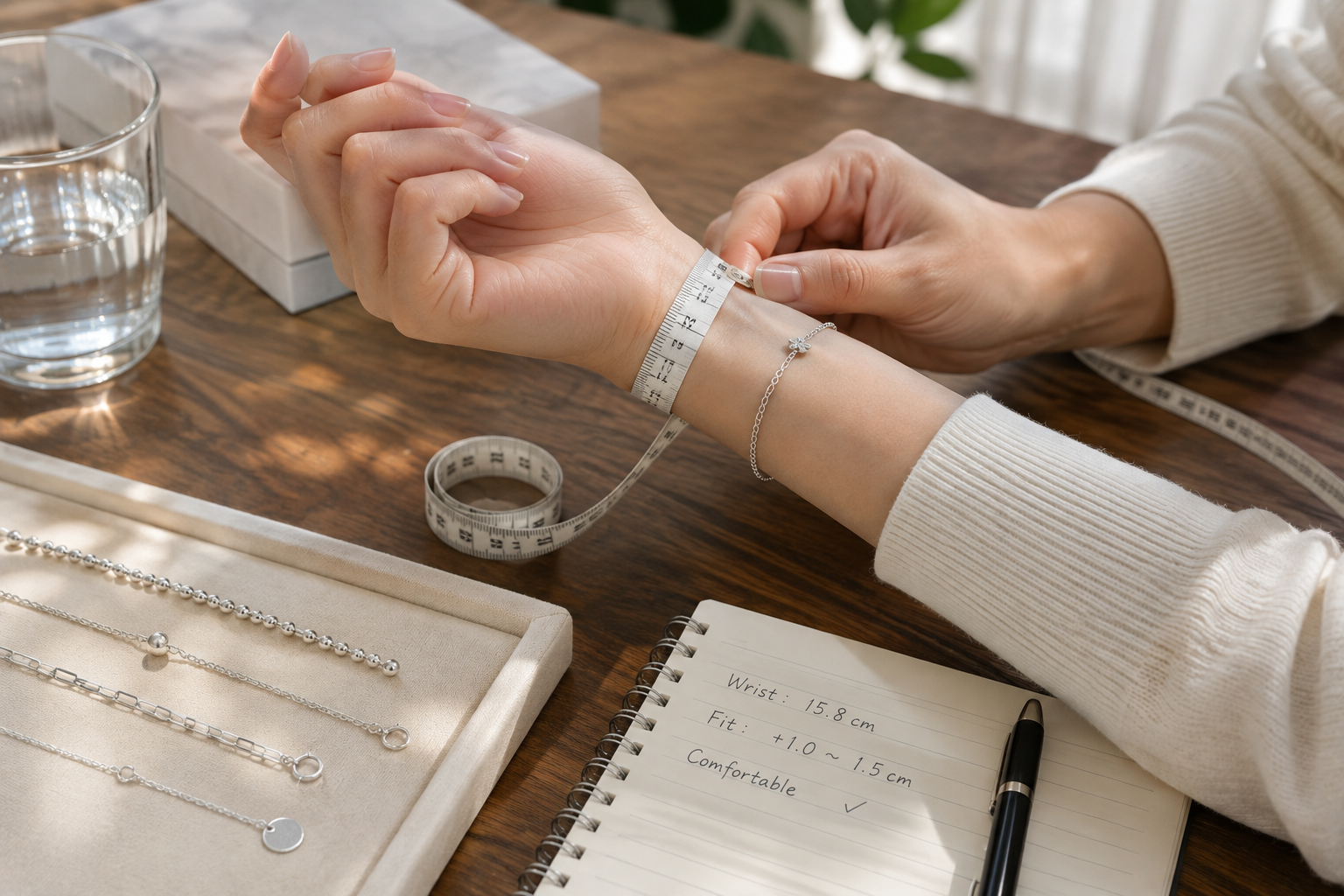
Wrist circumference is not the final bracelet length
A common mistake is to wrap a tape tightly around the wrist and use that number as the finished bracelet length. The measurement describes only the wrist. It does not include skin movement, wrist flexion, clasp thickness or personal preference. A bracelet that can just be closed is not necessarily comfortable for a full day.
A good fit allows the hand to lift, type, dress and carry objects without pressure, while remaining controlled enough not to flip constantly, slide onto the hand or strike the desk. The purpose of measuring is therefore to establish a base circumference and then choose a practical amount of ease.
Decide where the bracelet will actually sit
Some people wear a bracelet above the wrist bone for a stable position; others prefer it to move slightly towards the hand. Measure at the intended point rather than automatically using the narrowest part of the wrist. The left and right wrist can also differ, and the dominant hand may feel different during daily movement.
For stacking with a watch, decide which side of the watch the bracelet will occupy. The side closer to the hand moves more and may touch the watch case. The side closer to the forearm is usually steadier but interacts more with sleeves. The preferred ease can change with this position.
Using a soft tape: contact without compression
Wrap a flexible, non-stretch tape level around the chosen position. It should touch the skin naturally without leaving a deep mark. If a tape is unavailable, mark a non-stretch paper strip or cotton cord and measure it flat against a ruler.
- Keep the hand relaxed rather than clenched or fully spread;
- Keep the tape level instead of crossing the wrist bone diagonally;
- Repeat two or three times and check that the readings are close;
- Measure both wrists separately if either may wear the bracelet.
Add ease according to the way you like to wear it
There is no single allowance that suits every wrist and every design. The following ranges can be used as a starting point and adjusted for the structure:
- Close fit: about 0.5–1 cm above the wrist measurement for a light bracelet with little movement;
- Everyday comfort: about 1–1.5 cm for a balance of movement and stability;
- Loose fit: about 1.5–2 cm for a more visible drape.
These figures are references, not guarantees. Large beads, thick links, multiple charms and a bulky clasp occupy internal space and may need more allowance than a fine chain. For an adjustable sliding bracelet, focus on the minimum and maximum usable range rather than total length alone.
The clasp and connecting rings change the usable circumference
The stated total length may include the lobster clasp, extender and end decoration, but the closed loop around the wrist may not equal that total in every setting. An extender provides several fastening points, and each can create a different amount of tail movement. Check whether the page lists the main chain, the adjustable range or the maximum length including the extender.
Clasp operation also matters. A right-handed wearer putting a bracelet on the right wrist may find one-handed fastening difficult. For an older recipient or anyone who values easy handling, the adjustment and opening method may matter more than decorative complexity.
Desk work is a useful test of comfort
A bracelet can look correct in a still photograph and feel wrong while typing. A tight fit presses the skin as the wrist bends; a loose one may strike the desk, catch the keyboard edge or collide with a watch. Simulate the intended length with a cord and try typing, using a mouse and moving a sleeve over it.
For long-term wear, consider backpack straps, knit cuffs, hook-and-loop fasteners and exercise. Raised charms and fine connecting rings need more care in environments with frequent pulling. Comfort means not only the absence of a mark, but also that the bracelet does not constantly demand attention.
Bracelets and bangles use different measurements
A flexible bracelet is chosen mainly by wrist circumference and ease. A closed bangle must also pass over the widest part of the hand. An open bangle depends on inside diameter, opening width and whether its construction permits limited adjustment. Do not transfer a bracelet measurement directly to a bangle or repeatedly bend an open design to correct a poor size choice.
MEYINSOR bracelet and bangle pages state chain length, inside diameter, adjustment method or available size according to the design. Check the exact structure rather than relying only on the idea that your wrist is “small” or “average.”
Make a gentle first fitting after delivery
Try the clasp in a clean, dry place before wearing the bracelet for exercise, bathing or a long outing. Check whether it can move slightly, whether bending the wrist leaves a strong pressure mark, whether the clasp remains secure and whether the charm constantly turns underneath. If the size is clearly unsuitable, keep the packaging and product condition and contact the official service within the stated return or exchange period.
Final sizing checklist
- You measured the actual wearing position, not only the narrowest point;
- You recorded the base circumference and added ease for the design and preference;
- You distinguished total length, main chain, extender and adjustable range;
- You considered the clasp, charms, watch stacking and desk work;
- You used the correct method for a flexible bracelet, closed bangle or open bangle.
A suitable bracelet is neither fixed tightly against the wrist nor loose enough to lose control. It should move slightly with the hand without interrupting daily life. Measuring the wrist and leaving deliberate space is usually more reliable than choosing a bracelet that only just closes.