A larger pendant does not automatically wear better
Large pendants are easier to photograph. Their texture, setting and outline remain clear in a close-up, so they often create a stronger first impression. Product images, however, are usually taken at a short distance and make the pendant occupy more of the frame. In real life, people see the face, neck, shoulders, clothing and movement together rather than an isolated detail.
The useful question is not simply whether a pendant is large. Ask where it sits, whether the chain supports it, whether the neckline leaves enough open space and at what distance it is meant to be noticed. A well-proportioned small pendant can look complete, while an unbalanced large pendant can make everyday clothing feel unnecessarily heavy.
Turn the listed measurement into a real object
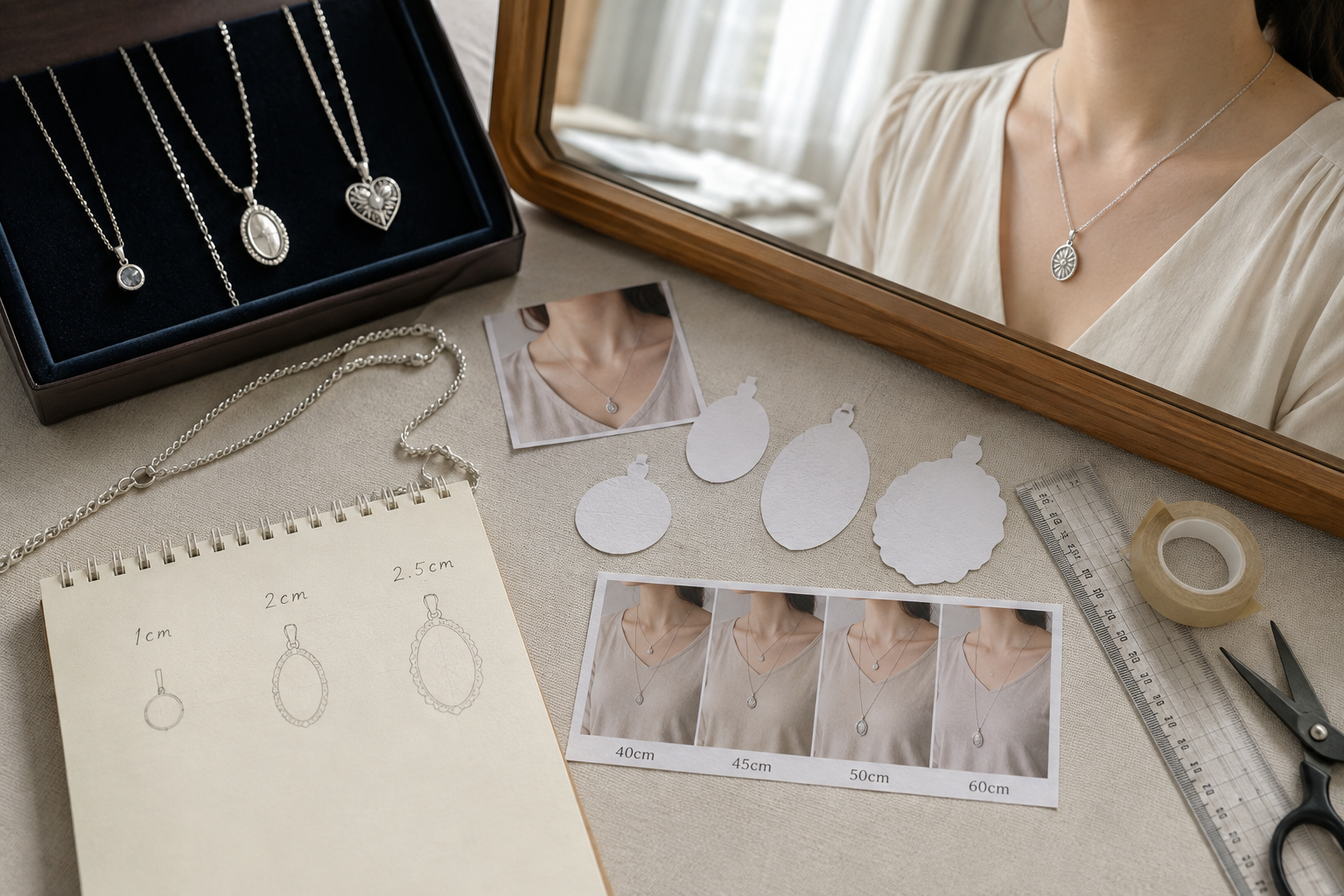
Product pages may give a diameter, height and width, or an approximate size. Do not rely on the number alone. Draw the stated dimensions on paper, cut out the shape and place it near the collarbone or neckline. A circle, a narrow vertical form and a wide motif can have the same longest measurement while occupying very different visual areas.
Check whether the measurement includes the connecting ring. Some dimensions refer to the main body only, while others include the top fitting. The full drop affects where the necklace sits and whether the pendant is likely to turn or touch the neckline.
The strength of a small pendant is everyday ease
A small pendant is usually lighter, creates less downward pull and works with more office, travel and daily clothing. Its presence comes from the silver surface, outline and detail rather than size. For someone who types frequently, wears shirts or changes outerwear often, a compact pendant tends to interfere less with movement.
Small should not become invisible by default. A very thick chain can overpower it, a wide open neckline may leave it without visual support, and complex details may become unreadable if reduced too far. A small pendant still needs a clear relationship with its chain and garment.
A larger pendant needs a complete area around it
A larger pendant can act as the visual centre of a plain top, an open neckline or a simple dress. It can give a quiet outfit a clear focal point and may suit a gift with a specific theme. In return, it usually needs a stable chain, suitable length and enough space across the chest.
Daily movement also matters. A larger piece may swing while walking, tip forward when bending or touch a desk, zip or shoulder strap. A still product photograph does not show what happens while working, driving or carrying a child.
Chain thickness decides whether the pendant feels supported
A fine chain with a small pendant can look light and precise. If the pendant is relatively heavy, the same chain may appear strained and create a strong downward pull. A thicker chain can support a bolder form but adds its own visual weight. The best match is not the thickest possible chain; it is one whose scale connects naturally with the pendant.
Look at the joint as well. A small bail can restrict movement, a long connector adds extra drop, and an off-centre weight makes a pendant more likely to flip. Front, side and wearing photographs together are more useful than a single straight-on close-up.
Face shape is not the only guide
Pendant advice is often reduced to face shape, but the pendant sits closer to the neck, collarbone and neckline. On narrow shoulders, a very wide piece may occupy most of the available space. A high neckline can hide a long narrow pendant, while a square or lower neckline can accommodate a fuller outline.
Instead of forcing the choice into a fixed face-shape formula, put on the tops you wear most and ask whether the pendant gives the eye a natural place to rest. Good proportion does not make the viewer notice “a very large object” first; it keeps the jewellery in balance with the person.
A bigger gift is not automatically a more considerate gift
A gift feels complete because the design suits the recipient, the packaging is prepared, and the material and after-sales information are clear. Size alone does not create that experience. When the recipient's clothing habits are unknown, a moderate weight, clean outline and compatibility with several necklines usually reduce the risk of the necklace being left unworn.
Read model and macro images differently
- Use the stated millimetre or centimetre dimensions, not only the image ratio;
- Check whether the wearing photograph shows a realistic scale;
- Treat macro photographs as workmanship views, not everyday viewing distance;
- Look for front and side views to judge flipping and depth;
- Consider pendant size together with chain length, neckline and daily activity.
Make a paper pendant before ordering
Draw and cut the stated outline from paper, then attach it lightly to a cord at the expected position. Try it with a crew neck, shirt and usual outer layer, and step back from the mirror. This simple test removes much of the scale distortion created by close-up product photography.
MEYINSOR necklace pages state chain length, pendant dimensions or the adjustment method for each design. Decide first whether you need a quiet everyday detail or a clear focal point, then return to the measurements. A necklace remains wearable not because it occupies the most attention, but because its proportions continue to feel right over time.